.png)


















TL;DR:
Coordinators spend more time on documentation than on participants: support plans, goal summaries, compliance checks, and review evidence eat the week. Supportly's upcoming AI Co-Pilot drafts plans, pulls goal progress from shift notes, and flags compliance gaps automatically, all pulled from a participant's real Supportly record. It doesn't replace professional judgement, family consultation, or coordinator sign-off, every draft still needs review before it's finalised. It's coming soon; join the waitlist for early access.
It's not even 10am and the day has already run away from you. Thirty active participants sit on your caseload. A plan review is due tomorrow, and the file isn't ready.
Three support plans need updating this week. Two compliance gaps from last month's internal review are still open. A participant's family has just called about their budget.
This is a normal Tuesday for a support coordinator. The caseload itself isn't the problem, the documentation layer sitting underneath it is.
That's the gap Supportly's AI Co-Pilot is built to close. It won't take your caseload off your hands. It removes the paperwork slowing you down while you manage it.
What Is an AI Co-Pilot in NDIS Care Management?
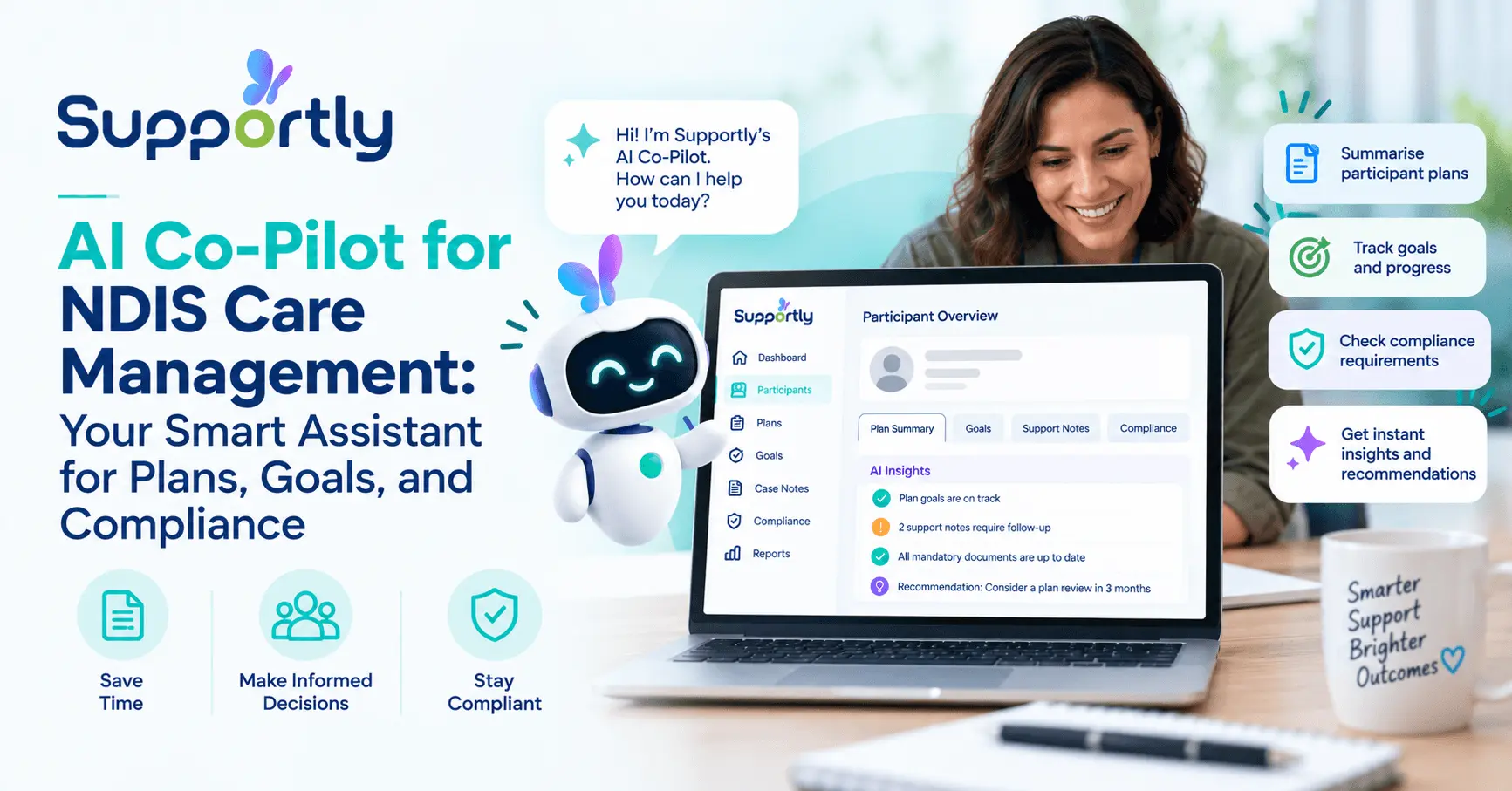
An AI co-pilot is an intelligent assistant built into your care management platform. It helps coordinators draft support plans, generate goal progress summaries, and flag compliance gaps.
It surfaces the participant information you need without forcing you to dig through separate records, tabs, or folders to find it.

The Four Documentation Tasks Eating Your Week
Support coordination isn't short on skill or care. It's short on hours, and most of those hours disappear into four recurring documentation tasks.
Support plan creation. Turning assessment data into a structured, funding-aligned plan takes real time, especially when you're starting from a blank template each time.
Goal progress documentation. Pulling months of shift notes into a coherent progress narrative for a plan review is slow, manual work. It's also easy to miss something buried in old records.
Compliance record maintenance. Spotting a documentation gap before it turns into an audit finding means checking records that don't always flag themselves.
Pre-plan-review evidence assembly. Before every plan review, someone has to gather the proof: what's been delivered, what's changed, and what's working.
These four tasks are exactly what Supportly's AI Co-Pilot is built to assist with. Not replace. Assist.
What Supportly's AI Co-Pilot Will Do
Support Plan Drafting
You input a participant's assessment data and current goals. The AI generates a structured draft plan, referencing the relevant NDIS funding categories and Practice Standards requirements.
From there, the work is yours. You review the draft, apply your professional judgement, and add the participant and family consultation context that makes a plan genuinely theirs.
The AI gives you a starting point instead of a blank page. It doesn't decide what a participant needs.
Goal Progress Summaries
Preparing for a plan review usually means reading back through weeks or months of shift notes, trying to piece together what progress actually looks like.
The AI Co-Pilot pulls the progress note history from a participant's record and identifies the events relevant to each goal. It then generates a draft progress narrative for you to review.
You're not writing from scratch anymore. You're checking and refining a summary that's already grounded in the participant's real documentation.
Compliance Gap Identification
Nobody wants to find out about a missing document during an audit. By then, it's too late to fix quietly.
The AI Co-Pilot reviews participant records against compliance requirements. It flags incomplete documentation, assessments approaching their review date, and service agreements that need updating.
Instead of running a manual audit across thirty files, you get a current gap list. You decide what to action and when.
How AI Co-Pilot Connects to Supportly's Care Management Module
The AI Co-Pilot isn't a separate tool bolted onto your workflow. It reads from the same live data already powering Supportly's care management module.
That means support plans, goal records, progress notes, funding balances, and incident history all feed into it directly.
Every suggestion the AI Co-Pilot makes is specific to that participant's own record. It's not pulling from a generic template library and hoping it fits.
This matters because NDIS documentation is never one-size-fits-all. A support plan built from someone else's goals and funding structure isn't useful, it's a liability.
What the AI Co-Pilot Does Not Replace
This is the part worth being honest about, because AI in care work only earns trust when its limits are named clearly.
The AI Co-Pilot assists with documentation structure and information retrieval. That's the extent of its role.
It does not replace your professional assessment of a participant's needs. Judgement calls about risk, capacity, and appropriate support remain yours.
It does not replace the participant and family consultation that has to underpin every support plan. No AI system sits in that conversation with you.
It does not replace your accountability for the accuracy of every document that goes into a participant's file. You review it, you finalise it, you own it.
And it does not replace the relationship that makes support coordination work in the first place. Software can organise information. It can't build trust with a participant or their family.
The Connected AI Layer: Co-Pilot and AI Case Notes Together
The AI Co-Pilot doesn't work in isolation from the rest of your team's documentation. It's connected to the shift notes your support workers are already logging.
Support workers in the field use AI Case Notes to generate consistent, goal-referenced shift notes as they go. That data doesn't sit static, it feeds directly into the Co-Pilot.
When the AI Co-Pilot generates a goal progress summary or assembles plan review evidence, it's drawing on that field documentation.
The better the shift notes, the sharper the Co-Pilot's summaries. Good documentation at the point of care makes the coordination layer above it stronger too.
That's the real value of a connected platform. Field and office data aren't separate systems that need reconciling, they're one continuous record.

Documentation Is the Barrier, Not Coordination
Care coordination has never been the part of this job that burns coordinators out. It's the documentation sitting behind every plan, every review, and every compliance check.
Supportly's AI Co-Pilot is built around that exact problem. It drafts, summarises, and flags, so coordinators spend more of the week where they're needed most: with participants, not paperwork.
It won't replace your judgement, your relationships, or your accountability. It's built to sit underneath your caseload, not take it over.
If your team is preparing for growth, audits, or simply trying to claw back hours each week, this is the feature to watch.
Want to see what's already live? Explore the Current Care Management Feature Set and get a full picture of how Supportly supports coordinators today, ahead of the AI Co-Pilot's release.
Have questions about how it'll fit your team's workflow? Book a Demo or Contact Us and talk it through with the Supportly team directly.
Frequently Asked Questions
When will Supportly's AI Co-Pilot be available, and how do I get early access?
The AI Co-Pilot is currently in development and listed as Coming Soon in Supportly's care management feature set. Providers can join the waitlist now for early access as the rollout begins.
What data does the Co-Pilot use to generate its suggestions?
It draws directly from each participant's existing record within Supportly, like support plans, goal history, progress notes, funding balances, and incident history. Nothing is pulled from outside sources or generic templates.
Do AI-drafted support plans satisfy NDIS Practice Standards documentation requirements?
An AI-generated draft is a starting point, not a finished document. The coordinator reviews, edits, and finalises every plan before it becomes part of the participant's official record, ensuring it meets Practice Standards.
Can coordinators edit the AI draft before it's saved to a participant's record?
Yes. Every draft, whether a support plan, goal summary, or compliance flag, is fully editable. Nothing saves to a participant's file without coordinator review and sign-off.
Can the Co-Pilot be switched off for specific participants or record types?
Providers will have control over where and how the AI Co-Pilot is used, including the ability to limit its involvement for specific participants or record categories, depending on individual provider policy and participant preference.